
Why Do I Feel Anxious, Even When Nothing’s Wrong?
Updated: Aug 18

From the outside, things look steady enough. You're managing work, keeping up with responsibilities, getting through what needs to be done. There may not be a clear problem to point to, no obvious crisis, no single event that explains why you feel the way you do.
And yet there's a constant sense of tension that never quite leaves you. Your mind stays active when you would rather it settled. Your body feels slightly braced, as though it's waiting for something. You might notice it in quiet moments, or when you finally stop at the end of the day. It's often less obvious when you're busy, but it's still there.
You might describe it as feeling on edge. Some people would call it anxiety. Often it sits somewhere in between. If you've found yourself wondering why you feel on edge for no clear reason, you're not alone, and it is more understandable than it might first appear.

What does feeling 'on edge' actually involve?
This experience is usually made up of a number of smaller patterns rather than one clear symptom. You may find it difficult to fully relax, even when you have the time. Sitting down doesn't necessarily bring a sense of rest and your mind continues to move, picking things over, anticipating what might be coming next, or replaying things that have already happened.
You might notice that you check things more than you need to. Or that you go over conversations in your head afterwards. Perhaps you feel slightly irritated or stretched, even when nothing significant's happened.
Sleep can be affected in a similar way. You may be tired, but your mind remains active. It's not always racing, but it doesn't fully settle either.
There is often a physical side to it too. You might feel tightness in the shoulders or chest, a sense of restlessness, or a feeling that your body is slightly more prepared than it needs to be. None of this is extreme, which is why it can be easy to dismiss, but over time it becomes wearing.
How do you feel right now? Think about it -
Is your jaw clenched?
Is your neck aching?
Is your stomach knotted?
There may be any number of things to notice. As I type, I'm realising that my shoulders are sitting higher than they should, braced for ... what?
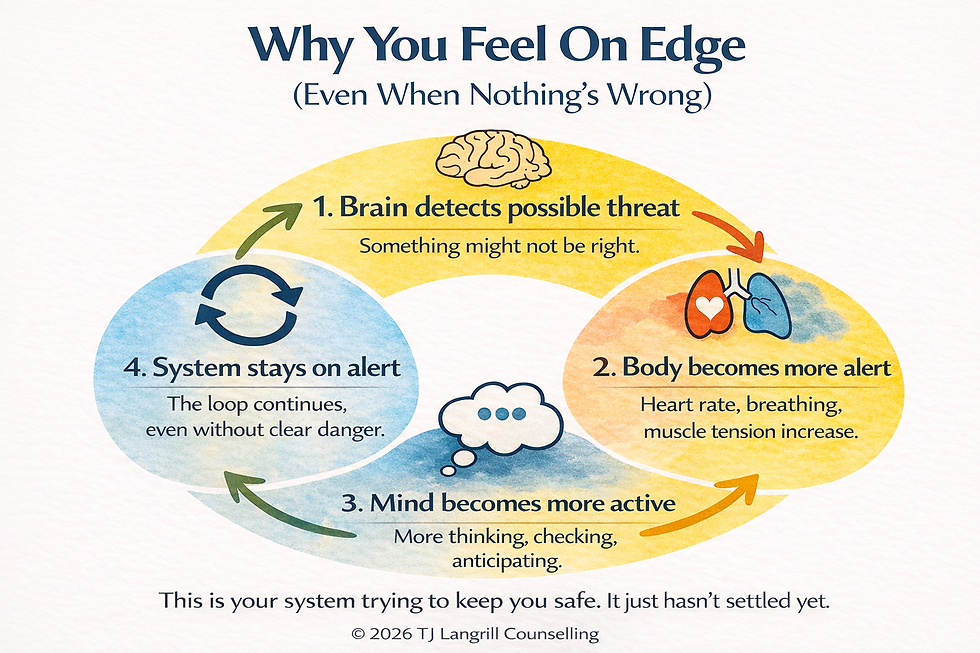
Why do I feel anxious? What's happening physically?
When we feel anxious or on edge without a clear reason, it can seem as though it's coming from nowhere. In reality, there's a process behind it.
The brain is amazing - it's constantly assessing for possible problems; this happens quickly and often outside of conscious awareness. It's not looking for definite danger, it's looking for anything that might require attention. If something's interpreted as a potential issue, even in a mild or uncertain way, your body responds by becoming more alert. Heart rate and breathing shift, muscles prepare, and your attention narrows slightly.
That physical shift then feeds back into your thinking and you may find yourself becoming more focused on what could go wrong, more inclined to check, plan or anticipate - not because you need to, but because your system is already slightly activated.
Over time, this becomes a loop. The brain detects, the body responds, the mind engages and the system remains slightly switched on. The original reason for that response may no longer be present, or may not be obvious but the pattern continues because it has been repeated often enough to become familiar.
You've rehearsed it so many times, it's now become an automatic pattern...
This is why it can feel as though it is coming from nowhere

Why it can happen when nothing seems wrong...
Default setting from the past? One of the more confusing aspects of this is that it often shows up when there is no clear current problem. Sometimes it reflects earlier periods where being alert was necessary (past traumatic events perhaps?). Your system learned that staying switched on was useful, and it continues to operate that way even when circumstances have changed.
Busy work life? Sometimes it's about pace (and this is so relevant for many of our 21st century lifestyles)... If you've spent a long time being busy or mentally engaged, your mind becomes used to that level of activity. When things slow down, it doesn't automatically follow. In fact, for some people, slowing down makes the feeling more noticeable.
Don't switch off? There is also the question of recovery. Many people have very little time where their system is not occupied. Even when they are resting, their mind remains active. Scrolling, thinking, planning, processing. Without periods where things genuinely settle, the baseline level of alertness remains higher than it needs to be.
None of this requires a dramatic explanation. It's often the accumulation of smaller pressures over time, rather than one clear cause.
What helps reduce that constant sense of tension
This doesn't usually change through force or quick fixes. Trying to switch it off often has the opposite effect. What tends to help is a gradual shift in how your system operates.
Understanding the pattern is a useful starting point. Not just knowing that it is “anxiety”, but seeing how the loop actually works for you. When things make sense, they tend to feel less overwhelming. It can also help to notice what keeps the loop going. For example, repeatedly checking, overthinking or trying to solve something that does not need solving can keep your system active, even when you're trying to settle.
Creating space where your mind and body are not required to be active or productive also matters. This is not about distraction or filling time, but about allowing a different pace to exist without immediately replacing it with more thinking. That might look like sitting down without immediately reaching for your phone, even if your mind stays busy at first. Maybe going for a walk without needing to achieve anything from it, not tracking steps or listening to something at the same time. Let yourself pause between one task and the next rather than filling every gap.
For some people, it is as simple as noticing the moment when they are about to check something again or run something over in their head, and choosing not to, just once. Not stopping the thought completely, but not following it either.
None of this is dramatic, and it doesn't feel like much in the moment. But these small shifts give your system a different experience. Over time, that is what allows the baseline level of tension to come down.
For many people, talking things through properly is what allows that shift to begin. Not because someone else provides answers, but because putting words to something that has been sitting in the background often changes how it is held.

A note from me
I work as a counsellor in Exeter, offering sessions in person and online across the UK ( as TJ Langrill Counselling). Much of my work centres around this kind of experience, where people are managing life but carrying a level of tension that has become familiar enough to overlook and uncomfortable enough to want to change.
My approach is straightforward and grounded. I draw on a range of therapeutic models, including Transactional Analysis, person centred therapy, and Internal Family Systems, but the focus is always on making sense of what is actually happening for you. Merlin the therapy dog works alongside me and is a positive asset for people struggling with anxiety and stress.
If you are feeling anxious or on edge and it is not settling, you are welcome to get in touch via www.tjlangrillcounselling.co.uk for a short initial conversation.


